

Avallone, KYC and compliance platform
How Avallone took non-engineer contributions from 2% to 22% in one summer
- 22%
- Of all merged pull requests are Kosuke-built
- +10%
- Merged PRs per week
- 92%
- Merge rate of Kosuke-built PRs
- 37%
- Of active builders are non-engineers
01 / About Avallone
KYC that cannot afford sloppy changes, or slow ones.
Avallone is a 360° KYC platform from Copenhagen: software plus expert services that let corporates, banks and funds collect, answer and manage KYC at scale. The company is SOC 2 Type II certified and lives inside compliance workflows all day, which means the product cannot afford sloppy changes and cannot afford slow ones either.
Ahmad Nazir Raja, Avallone's CTO, did not go looking for a vendor. He was already building the tool himself: Merlin, an internal platform to let everyone in the company contribute to the product. Then he met Kosuke, found the thing he was trying to build already running, and made the decision most CTOs hate making. He stopped building.
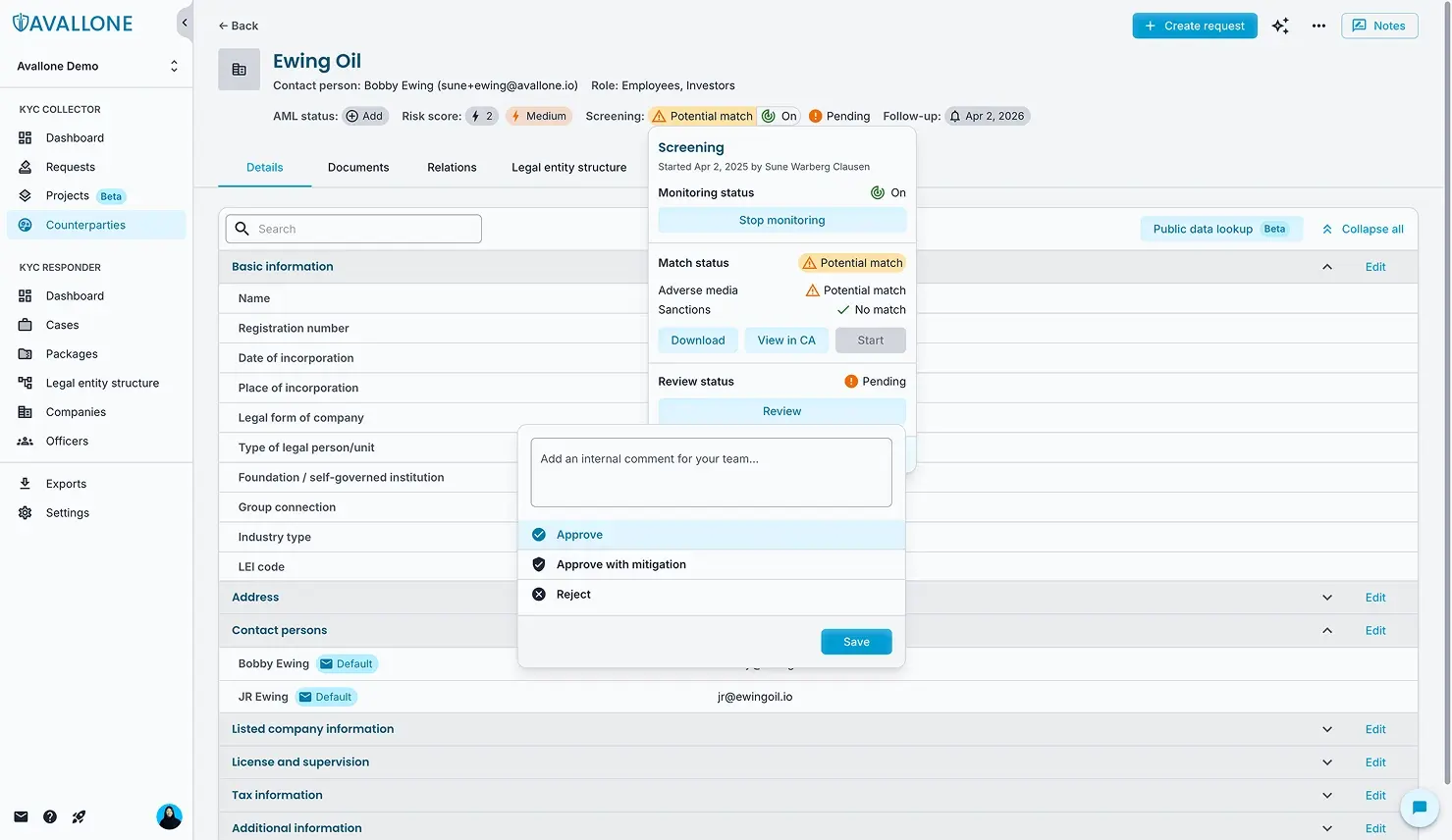
02 / The bottleneck
Ten minutes to understand, three weeks to reach production.
KYC product work is a stream of small, concrete tickets: a field to add, a flow to adjust, a template to fix, a customer request that takes ten minutes to understand and three weeks to reach production. Every one of them queued behind engineering.
The people closest to the customer, in product, customer success and compliance services, could see exactly what needed to change and could not touch it.
Waiting on engineering
4Product
Add a field to the entity form
Customer success
Adjust the collection flow for a fund
Compliance services
Fix the wording on a KYC template
Product
Customer request, ten minutes to understand
03 / Build or buy
The person who understood the problem best chose not to keep solving it.
Ahmad's answer was the one a good CTO gives: build the missing piece. Avallone started by making it easy for engineers to spin up the stack, so that prompting was easy. The next step was the cloud, so non-engineers could use it without fighting a local environment.
When he saw Kosuke, the comparison was uncomfortable and quick. He did what few founders manage to do with their own code: he stopped building and started onboarding. The strongest argument for Kosuke at Avallone is not a feature.
Merlin, built in house
Stopped
Kosuke, already running
Adopted
What it was
Merlin, built in house
Written with the engineering capacity left over from the product
Kosuke, already running
The same idea, in production, with the cloud sandboxes his version lacked
Who could use it
Merlin, built in house
Local environments only, so non-engineers could not
Kosuke, already running
Anyone, in the browser, with no local setup
Who maintained it
Merlin, built in house
The same team it was meant to unblock
Kosuke, already running
A team whose only job is to make it better
04 / Everyone ships, engineers review
Avallone did not lower the bar, it extended it to people who were locked out.
Within four months, 40% of Avallone's product and tech team was building on Kosuke. Of the active builders, 37% are not engineers: they are product managers, and they ship their own changes, in a live sandbox, in the browser, with no local setup.
What did not change is the gate. Every change lands as a pull request, and an engineer reviews and merges it.
- 40%
- Of the product and tech team building on Kosuke within four months
- 37%
- Of active builders are not engineers
- 100%
- Of changes land as a pull request an engineer reviews
05 / The numbers
Volume grew roughly 10x, the merge rate grew with it.
The share of Avallone's merges built with Kosuke grew roughly 10x between June and August. The merge rate tells the other half of the story: half of the first month's Kosuke-built pull requests got merged, then 90% or better every month since.
Share of merged pull requests built with Kosuke
June to August 2026, with the merge rate of those pull requests
22%
Of merges built with Kosuke, August
06 / In their words
The right split of responsibilities, finally workable.
"A builder needs three things to be effective: technical skill, domain knowledge, and product sense. It's rare for one person to have all three. The better model is to let people with deep domain knowledge and strong product sense build, while engineers review, approve, and maintain what gets built. That's the right split of responsibilities, and before Kosuke it was difficult to make it work in practice."

Ahmad Nazir Raja
CTO, Avallone
Everyone ships. Engineers review.