

Pillar, construction management software
How Pillar made everyone a builder by moving its dev environment to the cloud
- 3x
- People building on the codebase
- 8x
- PRs opened by Kosuke
- +19%
- Merged PRs per week
01 / About Pillar
Software for the people who build buildings.
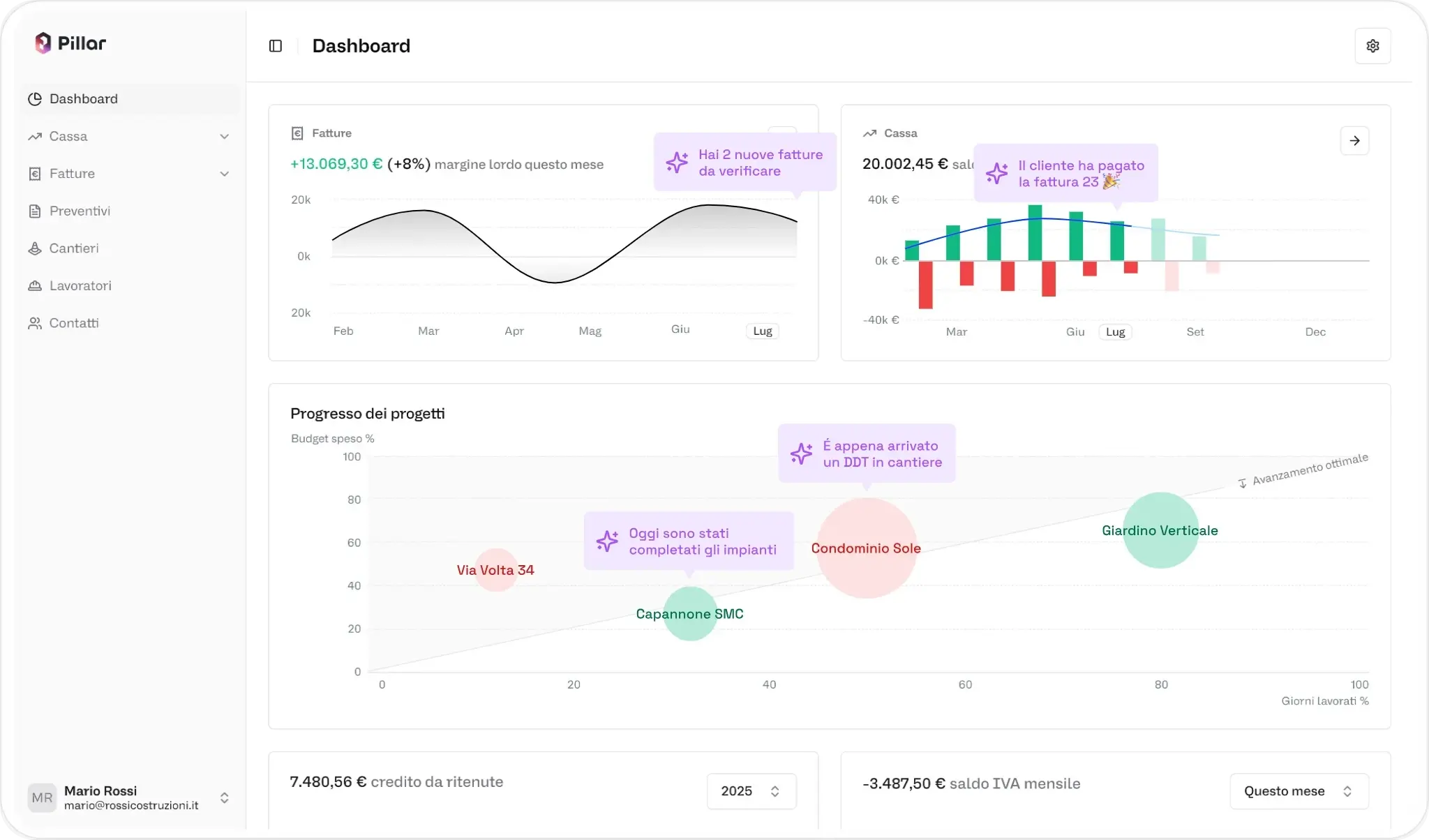
Pillar is the operating system for construction companies: cash flow, invoicing, quotations, procurement, site documentation and safety compliance in one platform, with an AI assistant on top. Over 700 construction firms run more than 2,000 projects on it, and users report saving hours of admin every week.
In May 2026 the Milan-based company closed a €12M seed round to expand across Europe, with plans to triple the team and reach thousands of active clients by 2027. The roadmap still grew faster than any hiring plan. Pillar's answer was infrastructure, not headcount.
02 / The bottleneck
A roadmap bigger than the team, on a stack too heavy for a laptop.
Every construction firm that signs up brings requests: a field on the quotation, a report for the site manager, a tweak to the invoicing flow. Each one is small, and each one used to become an engineering ticket.
Pillar did not just need more engineers. It needed a way for the people closest to the product and the customers to make safe, reviewable changes themselves. The stack was in the way: a resource-hungry platform with a multi-container Supabase backend that made local setup slow and painful even for developers, and out of reach for everyone else.
Small request, engineering ticket
3Construction firm
A field on the quotation
Site manager
A report for the job site
Finance
A tweak to the invoicing flow
03 / The infrastructure layer
Pillar did not buy a coding assistant, it changed where its software gets built.
The dev environment, the whole heavy stack with its multi-container backend, no longer lives on individual laptops. It runs in the cloud, on Kosuke, and every member of the team gets a live sandbox in the browser with the full platform running.
That is what makes everyone a builder. Not a lower bar, the same bar: every change lands as a pull request and an engineer merges it. The gate did not move, the number of people who can reach it did. And the layer is priced like infrastructure, by environments and sandbox hours on Pillar's own API keys, so a fast-growing company knows its ceiling before the month starts.
Engineers and designers
Maintain the product, and Storybook alongside it
Product managers
Prototype new features and take them to market
Operations and customer success
Fix the small bugs customers report, without a ticket
04 / Onboarding
The stack that made Kosuke stronger.
The platform needed more compute than a typical web app, so Kosuke added XL sandboxes. Its development environment runs on Supabase, a Docker Compose setup with half a dozen containers, while Kosuke runs each service of a stack as a process orchestrated inside the sandbox. Generalizing that model to Supabase took real engineering work.
It shipped, and today a stack like Pillar's comes up in minutes to an hour, automated end to end by agentic deploy, on any codebase. The browser-based setup also reduces the need to equip every contributor with a high-end laptop, a welcome cost benefit for a startup, even if it is not the reason Pillar made the move.
Built for this stack
16 CPU, 24 GB
XL sandboxes, added so a resource-hungry platform runs in the browser
Today, on any codebase
10 min to 1 hr
Agentic deploy brings the stack up, automated end to end
05 / The rollout
August was not about new faces, it was about depth.
In the first months, people across product, design, operations, engineering and customer success onboarded, and the number of people building on the codebase tripled between June and August.
Then the shape of the growth changed. In August the changes submitted for review grew more than three times over in a single month while the headcount on the tool barely moved, and weekly sandbox usage rose by a third.
Merged pull requests per week
The eight weeks before adoption against the eight weeks after
+19%
Merged PRs per week
06 / In their words
Not a compromise, the point.
"We needed to give everyone a way to contribute to the product, not only developers, but also designers, product managers and customer success. Designers can maintain Storybook, PMs can prototype features that make it to market, and customer success can fix small customer-reported bugs. Engineers still merge everything. That is not a compromise, that is the point."

Lorenzo Demaio
CPO and co-founder, Pillar
Everyone ships. Engineers review.